The Value of Using a Trading Journal: Unlocking Superior Trade Performance
Introduction
Hey there, trading enthusiasts! Are you ready to step up your game and take your trading strategies to new heights? Have you ever considered using a trading journal to track your trades and performance? Trust us, it’s not just a fancy notebook. It’s a ticket to a whole new level of financial success. But how? Let’s delve into the specifics.
The Power of Tracking Your Trades
Trading, like any other venture, is a journey laden with a wealth of experience and lessons to be learned. To become successful, we need to absorb these lessons and translate them into an improved performance in subsequent trades. But how do we remember each decision, its background, the outcome, and the lessons learned? The answer lies in the meticulous practice of tracking our trades.
Why Monitor Your Trades?
Think about it. Would you ever embark on a road trip without a map, blindly turning at intersections and hoping for the best? Of course not. You’d have a route planned out, carefully noting each turn and crossroad. Trading is no different.
By monitoring your trades, you’re effectively creating a map for your trading journey. You’re not just recording the decisions you make; you’re also tracking why you made those decisions, how you felt at the time, and how those trades eventually panned out.
It’s like keeping a detailed diary of your trading life. When you look back, you see a clear picture of your actions and their results. This bird’s eye view allows you to spot trends, identify recurring issues, and find areas for improvement.
In essence, monitoring your trades brings clarity. It cuts through the fog of uncertainty and exposes the road ahead, allowing you to navigate your trading journey with confidence.
Making Sense of Patterns
In the grand scheme of trading, patterns are worth their weight in gold. They’re the secret code that, once deciphered, can unlock unprecedented trading success. However, spotting these patterns is no easy task. Like looking for a constellation in the night sky, it requires a keen eye and an understanding of what you’re looking for.
That’s where a trading journal becomes your guiding star. By tracking your trades, you can start to see recurring themes and patterns. Maybe you’ll notice that a certain type of trade consistently yields positive results, or perhaps you’ll see that trades made under particular market conditions always seem to flop.
Either way, a trading journal helps you spot these patterns and understand them. This knowledge is invaluable in adjusting your trading strategy. You’ll learn what to steer clear of and what to pursue, allowing you to minimise losses and maximise gains.
The power of tracking your trades cannot be overstated. It’s not just about having a record; it’s about gaining insights into your trading habits, recognising patterns, and learning from each trade. It’s about becoming a smarter, more strategic trader. So, grab a journal, start tracking, and get ready to transform your trading journey!
The Anatomy of a Trading Journal
You might think that a trading journal is just a ledger to note down your transactions. But it’s more akin to a personal memoir, a frank and detailed account of your trading journey. Like a ship’s log in uncharted waters, it serves to guide and inform you, helping to shape your strategies and boost your performance.
What to Include in a Trading Journal
So, what should this ship’s log contain? Well, the first and most obvious answer is the details of your trades. This includes the asset, the price at which you bought and sold, the time of the trade, and the profit or loss resulting from it. But don’t stop there! Your trading journal should be as comprehensive as possible.
Remember those emotions that swirled in your mind when you made the trade? Write them down. How about your reasoning for entering or exiting the trade? Record that as well. Did any news or events influence your decision? Yes, you guessed it, that goes into the journal as well.
Your journal should also include a review of each trade. Did the trade go as expected? If not, why? Could anything have been done differently? By reflecting on each trade, you’ll learn from both your victories and your losses.
In short, your trading journal should be a detailed account of not just what you did, but also why you did it, how you felt about it, and what you learned from it.
Finding the Right Trading Journal Format for You
We’re all different, and the best trading journal format for you is the one that fits your trading style and preferences. Some traders prefer the tangibility of a paper journal. There’s something about the act of physically writing that can make the experience more meaningful and the lessons more memorable.
Others may prefer the convenience and functionality of a digital journal, such as a spreadsheet. This format allows for easy sorting and analysis of data, and the ability to add charts and graphs to visualise your trading performance. Plus, there’s the added benefit of being able to access your journal from anywhere, anytime.
Then, there are online platforms specifically designed for trading journals, offering pre-formatted templates and advanced analytics. These tools can be particularly beneficial for those who are serious about diving deep into their trading analytics.
The key is to experiment and find what works for you. The best format for your trading journal is the one that you’re comfortable with and that encourages you to consistently track and review your trades.
The anatomy of a trading journal is more complex than one might assume. It’s more than a record of numbers; it’s an introspective diary and a strategic blueprint. It helps to clarify the motivations behind your trades, reveals the emotional undertones, and showcases the hard-learned lessons. In short, it’s a beacon that guides your way in the turbulent seas of trading.
Comparing Types of Trading Journals: Written, Spreadsheet, or Online
Choosing the right type of trading journal is like finding the perfect running shoes. The right fit can make all the difference, affecting your comfort, performance, and willingness to stick with it. Here, we’ll take a closer look at the pros and cons of written journals, spreadsheets, and online trading journals, such as TradeViz.
Written Trading Journals
Nothing beats the old-school charm of a physical journal. The act of putting pen to paper can feel more personal and engaging, creating a strong emotional connection to your trading journey.
Market Mastery journal is a perfect solution to track your trading. On this paper-based journal, you can record your watch list, trades, emotions, technical emotions, set goals and take notes for your trading session.
Market Mastery journal on Amazon
Pros:
- Personal and tangible
- Easy to start and maintain
- No need for technical skills or equipment
Cons:
- Difficult to analyse data
- No automatic calculations
- Limited by physical space
Spreadsheet Trading Journals
The advent of digital technology brought us the spreadsheet – a flexible, functional tool that’s perfect for tracking and analysing trades.
Pros:
- Customisable to your needs
- Can perform automatic calculations
- Easy to sort and analyse data
Cons:
- Requires basic knowledge of spreadsheet functions
- Can become complex and unwieldy
- Risk of data loss if not backed up properly
Hybrid Digital Paper
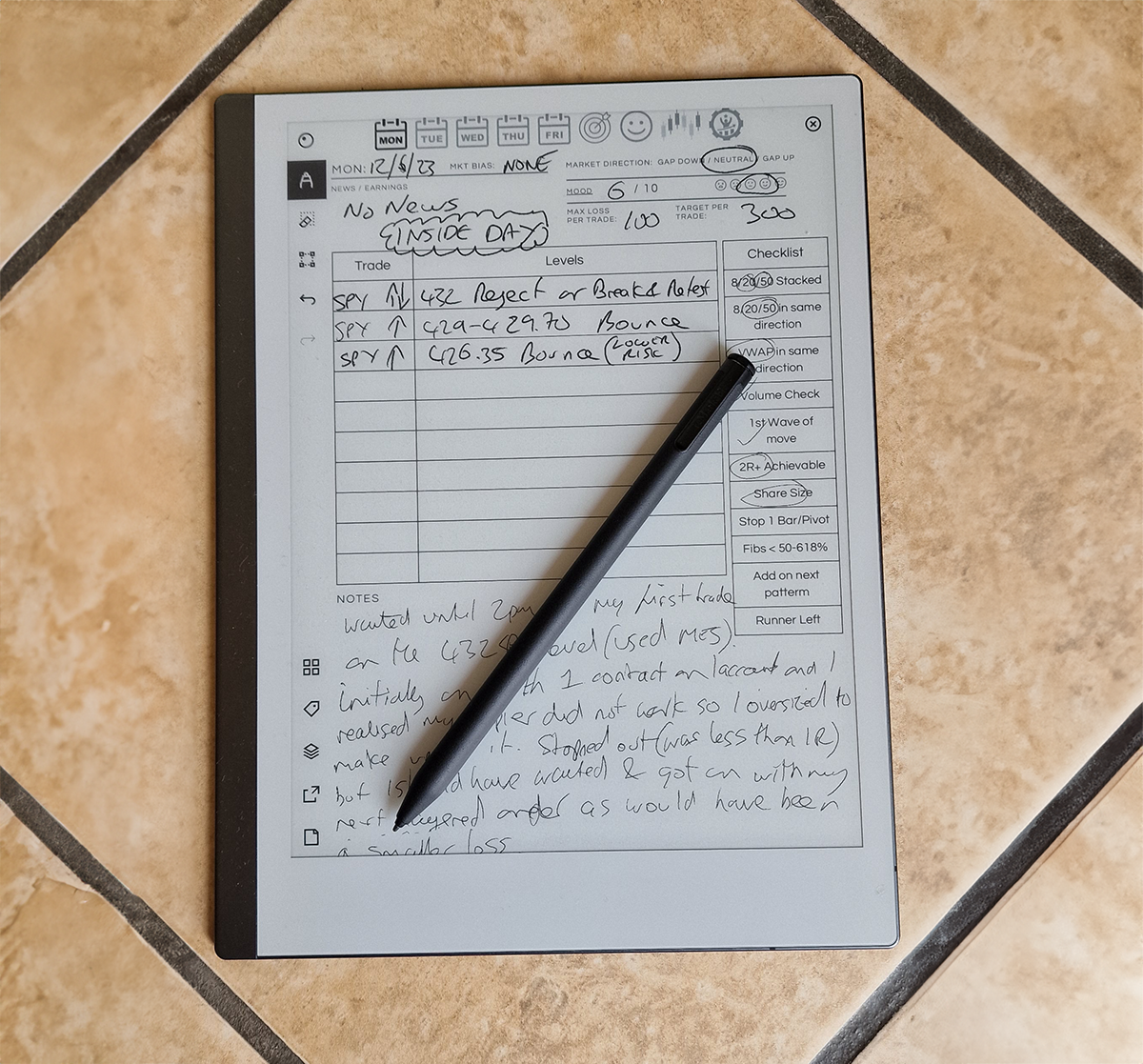
Love the idea of physically writing down your notes and ideas but also want to keep your notes online to access and search for at any time from your phone or computer? I highly recommend a digital notepad such as the Remarkable 2 (see this amazing article on how I use it in my own trading) and you get the best of both worlds!
Online Trading Journals like TradeViz
Online trading journals such as TradeViz offer a tailored experience for traders. They provide advanced features and analytics to help you track and analyse your trades in depth. With TradeViz, you can visualise your trading performance, spot trends, and get valuable insights to enhance your trading strategy. The best part? You can get a 15% discount on TradeViz with this link!
Pros:
- Tailored specifically for trading
- Advanced features and analytics
- Accessible from anywhere with an internet connection
- TradeViz has a limited free option.
Cons:
- Professional users may require a subscription fee
- Might be overwhelming for beginners
- Dependence on the service provider for data security
Choosing the right trading journal boils down to personal preference, needs, and trading style. Some may find the simplicity of a written journal appealing, while others might prefer the analytical prowess of a spreadsheet. For those who want a comprehensive solution with advanced features, online trading journals like TradeViz can be an excellent choice. Whatever your choice, remember that the goal is to learn and grow as a trader. Choose the tool that helps you achieve that.
Frequently Asked Questions about Trading Journals
1. Why do I need a trading journal?
A trading journal is like a personal coach. It provides insights into your trading habits, identifies patterns, highlights areas for improvement, and tracks your progress. With a trading journal, you can learn from each trade, continually refining your strategies to become a better trader.
2. What should I include in my trading journal?
At a minimum, your trading journal should include the details of each trade (asset, price, time, and result). However, to gain the maximum benefit, your journal should also record your thoughts and emotions during the trade, any influencing factors, and a post-trade review.
3. How often should I review my trading journal?
Regular reviews are vital for learning from your journal. At a minimum, you should review your journal at the end of each trading week. However, more frequent reviews can help you identify trends and make adjustments more quickly.
4. I’m just a beginner. Do I really need a trading journal?
Absolutely! In fact, a trading journal can be especially valuable for beginners. It’s an excellent tool for learning the ropes, understanding your trading style, and developing good habits early in your trading journey.
5. How can I analyse the data in my trading journal?
The method of analysis will depend on the format of your journal. For written journals, you’ll need to do manual analysis. In spreadsheets, you can use built-in functions to calculate averages, identify trends, and more. Online trading journals, like TradeViz, offer advanced analytics features.
6. Isn’t keeping a trading journal time-consuming?
Maintaining a trading journal does require a commitment of time. However, the benefits far outweigh the costs. The insights and improvements that a trading journal can bring to your trading performance are invaluable. Like any investment, the time you put into your trading journal can yield significant returns.
7. Can I use a trading journal for all types of trading?
Yes, a trading journal can be beneficial for all types of trading, including stocks, forex, commodities, and even cryptocurrencies. Whatever market you’re in, a trading journal can help you understand your trades and improve your strategy.
8. What are the advantages of using a written trading journal?
A written trading journal offers a personal and tangible experience. It’s easy to start, doesn’t require any special technical skills, and can create a stronger emotional connection to your trading journey. Plus, there’s something quite satisfying about physically writing down your thoughts and reflections.
9. What makes spreadsheet trading journals a popular choice?
Spreadsheet journals, like those created in Excel or Google Sheets, offer flexibility and functionality. You can customise the format to your liking, use formulas to automatically calculate metrics, and easily sort and analyse your data. It’s a digital upgrade to the traditional written journal.
10. How does an online trading journal like TradeViz enhance my trading experience?
Online trading journals such as TradeViz offer advanced features tailored specifically for traders. These platforms enable you to visualise your trading performance, track your trades in real-time, and get valuable insights from your data. Plus, you can access your journal from anywhere, which adds to the convenience.
11. I’m not very tech-savvy. Can I still use an online trading journal?
Absolutely! Online trading journals are designed to be user-friendly. While there might be a learning curve initially, most platforms offer tutorials or customer support to help you get started. Plus, the benefits of the advanced features and analytics offered by these platforms are well worth the initial effort.
12. Can I switch between different types of trading journals?
Yes, you can switch between different types of journals based on your evolving needs and preferences. The important thing is to maintain consistency in tracking your trades and reflecting on your performance. Remember, the value of a trading journal lies in the insights it provides, regardless of its format.
Remember, the goal is not to choose the ‘best’ journal, but rather to find the one that best suits your needs, trading style, and comfort level. Whether you opt for the charm of a written journal, the functionality of a spreadsheet, or the advanced features of an online platform like TradeViz, the key is to use your journal regularly and effectively to enhance your trading performance.
Stay in the loop.
Get trading lessons and updates in your inbox, or join the conversation on Discord.